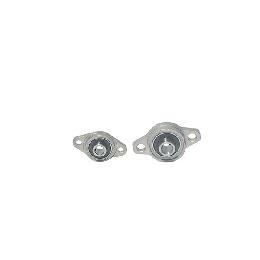
Reduce upkeep with sleeve bearings that lubricate themselves. Made from porous, oil-saturated bronze, they release a thin film of lubrication upon startup to keep shafts spinning. With no moving parts, sleeve bearings withstand dusty, dirty environments better than ball or roller bearings. However, with more friction generated, they're less effective at high speeds. The sturdy housing supports the shaft and secures with a two-bolt flange, the most common type of flanged bearing. Aluminum Housing — One-third the weight of cast iron but not as strong. Aluminum also resists corrosion. Misalignment Capability — Bearings compensate for as much shaft misalignment as the degree listed. This extends the life of the bearing and protects against wear if shafts are slightly askew.