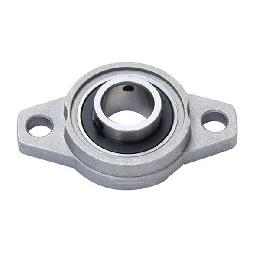
With simple, lightweight designs, these bearings are a cost-effective option when extreme precision isn't necessary. Less stable than bearings with forged, one-piece housings, they're good for hand-cranked systems, gravity feed conveyor rollers, and other low-speed applications. Inside, the sleeve is made of naturally slick plastic that doesn't require lubrication. They'll keep shafts spinning with no messy grease to drip off, wash out, or collect dust. With no moving parts, sleeve bearings stand up to grimy environments better than ball bearings. However, with more friction generated, they're less effective at high speeds. The housing mounts in place with a two-bolt flange, the most common type of flanged bearing. Nylon — Nylon bearings are wear-resistant and economical. They're best in dry environments, as exposure to moisture will cause them to weaken and swell.
With simple, lightweight designs, these bearings are a cost-effective option when extreme precision isn't necessary. Less stable than bearings with forged, one-piece housings, they're good for hand-cranked systems, gravity feed conveyor rollers, and other low-speed applications. Inside, the sleeve is made of naturally slick plastic that doesn't require lubrication. They'll keep shafts spinning with no messy grease to drip off, wash out, or collect dust. With no moving parts, sleeve bearings stand up to grimy environments better than ball bearings. However, with more friction generated, they're less effective at high speeds. The housing mounts in place with a two-bolt flange, the most common type of flanged bearing. Ultra - Low - Friction PTFE - Filled Acetal — Made from a special blend of acetal and PTFE, these extra-slippery bearings are ideal for conveyors and other machinery with frequent starts and stops. Steel Housing — Best for dry environments as moisture will cause them to rust. Misalignment Capability — Bearings compensate for as much shaft misalignment as the degree listed. This extends the life of the bearing and protects against wear if shafts are slightly askew.
With simple, lightweight designs, these bearings are a cost-effective option when extreme precision isn't necessary. Less stable than bearings with forged, one-piece housings, they're good for hand-cranked systems, gravity feed conveyor rollers, and other low-speed applications. Inside, the sleeve is made of naturally slick plastic that doesn't require lubrication. They'll keep shafts spinning with no messy grease to drip off, wash out, or collect dust. With no moving parts, sleeve bearings stand up to grimy environments better than ball bearings. However, with more friction generated, they're less effective at high speeds. The housing mounts in place with a two-bolt flange, the most common type of flanged bearing. Acetal — The most common choice for plastic bearings, acetal is wear-resistant and affordable. Steel Housing — Best for dry environments as moisture will cause them to rust. Misalignment Capability — Bearings compensate for as much shaft misalignment as the degree listed. This extends the life of the bearing and protects against wear if shafts are slightly askew.