The thicker inner and outer raceways on these bearings can handle heavier loads than the thin-profile crossed-roller bearings. The rollers face in alternating directions to allow for rigid, accurate motion under any combination of radial, thrust, and moment (twisting) loads. Use in applications where highly accurate motion is necessary, such as machine tools and industrial robots. Open Bearing — Open bearings dissipate heat more efficiently than sealed bearings.
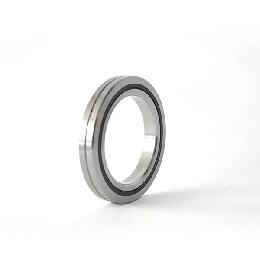
The thicker inner and outer raceways on these bearings can handle heavier loads than the thin-profile crossed-roller bearings. The rollers face in alternating directions to allow for rigid, accurate motion under any combination of radial, thrust, and moment (twisting) loads. Use in applications where highly accurate motion is necessary, such as machine tools and industrial robots. Sealed Bearing — Sealed bearings block out dust and other contaminants better than open bearings, but retain more heat.