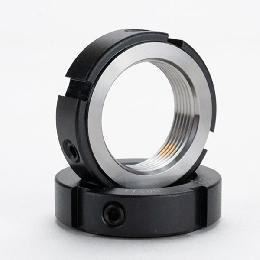
Used in pairs or with another bearing nut, these thin-profile nuts—often called shaft nuts—hold bearings, bushings, pulleys, and gears in place on your threaded shaft or spindle. Threading two nuts tightly against each other makes it harder for vibration to loosen your assembly than if you used only one nut. For the nut closer to the bearing, position the stepped face towards the bearing. These thin-profile nuts have holes on the side, so you can tighten and loosen them with a pin spanner wrench. All meet DIN 1816, an international standard for bearing locknut dimensions.