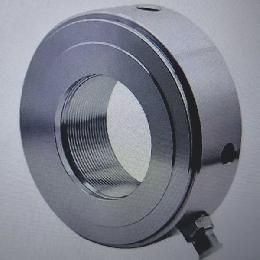
With a nylon insert that grips your threaded shaft or spindle without damaging its threads, these locknuts— also called shaft nuts— hold bearings, bushings, gears, and pulleys prone to vibration tightly in place. They come as one piece, so you can easily clamp them onto your shaft or spindle. But, since they aren’t made entirely of metal, they don’t stand up to heat as well as all-metal locknuts. Slots in their sides mean you can tighten and loosen them with a spanner wrench or spanner socket. Their face is also chamfered to help keep the size and weight of your assembly at a minimum. All meet international standards for bearing locknut dimensions. Carbon Steel — All carbon steel locknuts are strong and resist wear, though they don’t stand up to corrosion as well as 303 stainless steel locknuts. Thread Spacing — When choosing your thread spacing, consider the precision of your application. The finer the threads, the more control you have when making adjustments.
For easy tightening and loosening, these sockets have pins that grip the slotted sides on bearing nuts . These sockets require less clearance around bearings than standard hook spanner wrenches, so they’re good in tight spaces. Use them with a square-drive wrench handle or a ratchet wrench ; they’re not for use with impact wrenches.
With a nylon insert that grips your threaded shaft or spindle without damaging its threads, these locknuts— also called shaft nuts— hold bearings, bushings, gears, and pulleys prone to vibration tightly in place. They come as one piece, so you can easily clamp them onto your shaft or spindle. But, since they aren’t made entirely of metal, they don’t stand up to heat as well as all-metal locknuts. Slots in their sides mean you can tighten and loosen them with a spanner wrench or spanner socket. Their face is also chamfered to help keep the size and weight of your assembly at a minimum. All meet international standards for bearing locknut dimensions. Carbon Steel — All carbon steel locknuts are strong and resist wear, though they don’t stand up to corrosion as well as 303 stainless steel locknuts. Thread Spacing — When choosing your thread spacing, consider the precision of your application. The finer the threads, the more control you have when making adjustments.
For easy tightening and loosening, these sockets have pins that grip the slotted sides on bearing nuts . These sockets require less clearance around bearings than standard hook spanner wrenches, so they’re good in tight spaces. Use them with a square-drive wrench handle or a ratchet wrench ; they’re not for use with impact wrenches.
With a nylon insert that grips your threaded shaft or spindle without damaging its threads, these locknuts— also called shaft nuts— hold bearings, bushings, gears, and pulleys prone to vibration tightly in place. They come as one piece, so you can easily clamp them onto your shaft or spindle. But, since they aren’t made entirely of metal, they don’t stand up to heat as well as all-metal locknuts. Slots in their sides mean you can tighten and loosen them with a spanner wrench or spanner socket. Their face is also chamfered to help keep the size and weight of your assembly at a minimum. All meet international standards for bearing locknut dimensions. Carbon Steel — All carbon steel locknuts are strong and resist wear, though they don’t stand up to corrosion as well as 303 stainless steel locknuts. Thread Spacing — When choosing your thread spacing, consider the precision of your application. The finer the threads, the more control you have when making adjustments.
For easy tightening and loosening, these sockets have pins that grip the slotted sides on bearing nuts . These sockets require less clearance around bearings than standard hook spanner wrenches, so they’re good in tight spaces. Use them with a square-drive wrench handle or a ratchet wrench ; they’re not for use with impact wrenches.
With a nylon insert that grips your threaded shaft or spindle without damaging its threads, these locknuts— also called shaft nuts— hold bearings, bushings, gears, and pulleys prone to vibration tightly in place. They come as one piece, so you can easily clamp them onto your shaft or spindle. But, since they aren’t made entirely of metal, they don’t stand up to heat as well as all-metal locknuts. Slots in their sides mean you can tighten and loosen them with a spanner wrench or spanner socket. Their face is also chamfered to help keep the size and weight of your assembly at a minimum. All meet international standards for bearing locknut dimensions. Carbon Steel — All carbon steel locknuts are strong and resist wear, though they don’t stand up to corrosion as well as 303 stainless steel locknuts. Thread Spacing — When choosing your thread spacing, consider the precision of your application. The finer the threads, the more control you have when making adjustments.
For easy tightening and loosening, these sockets have pins that grip the slotted sides on bearing nuts . These sockets require less clearance around bearings than standard hook spanner wrenches, so they’re good in tight spaces. Use them with a square-drive wrench handle or a ratchet wrench ; they’re not for use with impact wrenches.
With a nylon insert that grips your threaded shaft or spindle without damaging its threads, these locknuts— also called shaft nuts— hold bearings, bushings, gears, and pulleys prone to vibration tightly in place. They come as one piece, so you can easily clamp them onto your shaft or spindle. But, since they aren’t made entirely of metal, they don’t stand up to heat as well as all-metal locknuts. Slots in their sides mean you can tighten and loosen them with a spanner wrench or spanner socket. Their face is also chamfered to help keep the size and weight of your assembly at a minimum. All meet international standards for bearing locknut dimensions. Carbon Steel — All carbon steel locknuts are strong and resist wear, though they don’t stand up to corrosion as well as 303 stainless steel locknuts. Thread Spacing — When choosing your thread spacing, consider the precision of your application. The finer the threads, the more control you have when making adjustments.
For easy tightening and loosening, these sockets have pins that grip the slotted sides on bearing nuts . These sockets require less clearance around bearings than standard hook spanner wrenches, so they’re good in tight spaces. Use them with a square-drive wrench handle or a ratchet wrench ; they’re not for use with impact wrenches.
With a nylon insert that grips your threaded shaft or spindle without damaging its threads, these locknuts— also called shaft nuts— hold bearings, bushings, gears, and pulleys prone to vibration tightly in place. They come as one piece, so you can easily clamp them onto your shaft or spindle. But, since they aren’t made entirely of metal, they don’t stand up to heat as well as all-metal locknuts. Slots in their sides mean you can tighten and loosen them with a spanner wrench or spanner socket. Their face is also chamfered to help keep the size and weight of your assembly at a minimum. All meet international standards for bearing locknut dimensions. Carbon Steel — All carbon steel locknuts are strong and resist wear, though they don’t stand up to corrosion as well as 303 stainless steel locknuts. Thread Spacing — When choosing your thread spacing, consider the precision of your application. The finer the threads, the more control you have when making adjustments.
For easy tightening and loosening, these sockets have pins that grip the slotted sides on bearing nuts . These sockets require less clearance around bearings than standard hook spanner wrenches, so they’re good in tight spaces. Use them with a square-drive wrench handle or a ratchet wrench ; they’re not for use with impact wrenches.
With a nylon insert that grips your threaded shaft or spindle without damaging its threads, these locknuts— also called shaft nuts— hold bearings, bushings, gears, and pulleys prone to vibration tightly in place. They come as one piece, so you can easily clamp them onto your shaft or spindle. But, since they aren’t made entirely of metal, they don’t stand up to heat as well as all-metal locknuts. Slots in their sides mean you can tighten and loosen them with a spanner wrench or spanner socket. Their face is also chamfered to help keep the size and weight of your assembly at a minimum. All meet international standards for bearing locknut dimensions. Carbon Steel — All carbon steel locknuts are strong and resist wear, though they don’t stand up to corrosion as well as 303 stainless steel locknuts. Thread Spacing — When choosing your thread spacing, consider the precision of your application. The finer the threads, the more control you have when making adjustments.
For easy tightening and loosening, these sockets have pins that grip the slotted sides on bearing nuts . These sockets require less clearance around bearings than standard hook spanner wrenches, so they’re good in tight spaces. Use them with a square-drive wrench handle or a ratchet wrench ; they’re not for use with impact wrenches.
With a nylon insert that grips your threaded shaft or spindle without damaging its threads, these locknuts— also called shaft nuts— hold bearings, bushings, gears, and pulleys prone to vibration tightly in place. They come as one piece, so you can easily clamp them onto your shaft or spindle. But, since they aren’t made entirely of metal, they don’t stand up to heat as well as all-metal locknuts. Slots in their sides mean you can tighten and loosen them with a spanner wrench or spanner socket. Their face is also chamfered to help keep the size and weight of your assembly at a minimum. All meet international standards for bearing locknut dimensions. Carbon Steel — All carbon steel locknuts are strong and resist wear, though they don’t stand up to corrosion as well as 303 stainless steel locknuts. Thread Spacing — When choosing your thread spacing, consider the precision of your application. The finer the threads, the more control you have when making adjustments.
For easy tightening and loosening, these sockets have pins that grip the slotted sides on bearing nuts . These sockets require less clearance around bearings than standard hook spanner wrenches, so they’re good in tight spaces. Use them with a square-drive wrench handle or a ratchet wrench ; they’re not for use with impact wrenches.
With a nylon insert that grips your threaded shaft or spindle without damaging its threads, these locknuts— also called shaft nuts— hold bearings, bushings, gears, and pulleys prone to vibration tightly in place. They come as one piece, so you can easily clamp them onto your shaft or spindle. But, since they aren’t made entirely of metal, they don’t stand up to heat as well as all-metal locknuts. Slots in their sides mean you can tighten and loosen them with a spanner wrench or spanner socket. Their face is also chamfered to help keep the size and weight of your assembly at a minimum. All meet international standards for bearing locknut dimensions. Carbon Steel — All carbon steel locknuts are strong and resist wear, though they don’t stand up to corrosion as well as 303 stainless steel locknuts. Thread Spacing — When choosing your thread spacing, consider the precision of your application. The finer the threads, the more control you have when making adjustments.
For easy tightening and loosening, these sockets have pins that grip the slotted sides on bearing nuts . These sockets require less clearance around bearings than standard hook spanner wrenches, so they’re good in tight spaces. Use them with a square-drive wrench handle or a ratchet wrench ; they’re not for use with impact wrenches.
With a nylon insert that grips your threaded shaft or spindle without damaging its threads, these locknuts— also called shaft nuts— hold bearings, bushings, gears, and pulleys prone to vibration tightly in place. They come as one piece, so you can easily clamp them onto your shaft or spindle. But, since they aren’t made entirely of metal, they don’t stand up to heat as well as all-metal locknuts. Slots in their sides mean you can tighten and loosen them with a spanner wrench or spanner socket. Their face is also chamfered to help keep the size and weight of your assembly at a minimum. All meet international standards for bearing locknut dimensions. Carbon Steel — All carbon steel locknuts are strong and resist wear, though they don’t stand up to corrosion as well as 303 stainless steel locknuts. Thread Spacing — When choosing your thread spacing, consider the precision of your application. The finer the threads, the more control you have when making adjustments.
For easy tightening and loosening, these sockets have pins that grip the slotted sides on bearing nuts . These sockets require less clearance around bearings than standard hook spanner wrenches, so they’re good in tight spaces. Use them with a square-drive wrench handle or a ratchet wrench ; they’re not for use with impact wrenches.
With a nylon insert that grips your threaded shaft or spindle without damaging its threads, these locknuts— also called shaft nuts— hold bearings, bushings, gears, and pulleys prone to vibration tightly in place. They come as one piece, so you can easily clamp them onto your shaft or spindle. But, since they aren’t made entirely of metal, they don’t stand up to heat as well as all-metal locknuts. Slots in their sides mean you can tighten and loosen them with a spanner wrench or spanner socket. Their face is also chamfered to help keep the size and weight of your assembly at a minimum. All meet international standards for bearing locknut dimensions. Carbon Steel — All carbon steel locknuts are strong and resist wear, though they don’t stand up to corrosion as well as 303 stainless steel locknuts. Thread Spacing — When choosing your thread spacing, consider the precision of your application. The finer the threads, the more control you have when making adjustments.
For easy tightening and loosening, these sockets have pins that grip the slotted sides on bearing nuts . These sockets require less clearance around bearings than standard hook spanner wrenches, so they’re good in tight spaces. Use them with a square-drive wrench handle or a ratchet wrench ; they’re not for use with impact wrenches.
With a nylon insert that grips your threaded shaft or spindle without damaging its threads, these locknuts— also called shaft nuts— hold bearings, bushings, gears, and pulleys prone to vibration tightly in place. They come as one piece, so you can easily clamp them onto your shaft or spindle. But, since they aren’t made entirely of metal, they don’t stand up to heat as well as all-metal locknuts. Slots in their sides mean you can tighten and loosen them with a spanner wrench or spanner socket. Their face is also chamfered to help keep the size and weight of your assembly at a minimum. All meet international standards for bearing locknut dimensions. Carbon Steel — All carbon steel locknuts are strong and resist wear, though they don’t stand up to corrosion as well as 303 stainless steel locknuts. Thread Spacing — When choosing your thread spacing, consider the precision of your application. The finer the threads, the more control you have when making adjustments.
For easy tightening and loosening, these sockets have pins that grip the slotted sides on bearing nuts . These sockets require less clearance around bearings than standard hook spanner wrenches, so they’re good in tight spaces. Use them with a square-drive wrench handle or a ratchet wrench ; they’re not for use with impact wrenches.
With a nylon insert that grips your threaded shaft or spindle without damaging its threads, these locknuts— also called shaft nuts— hold bearings, bushings, gears, and pulleys prone to vibration tightly in place. They come as one piece, so you can easily clamp them onto your shaft or spindle. But, since they aren’t made entirely of metal, they don’t stand up to heat as well as all-metal locknuts. Slots in their sides mean you can tighten and loosen them with a spanner wrench or spanner socket. Their face is also chamfered to help keep the size and weight of your assembly at a minimum. All meet international standards for bearing locknut dimensions. Carbon Steel — All carbon steel locknuts are strong and resist wear, though they don’t stand up to corrosion as well as 303 stainless steel locknuts. Thread Spacing — When choosing your thread spacing, consider the precision of your application. The finer the threads, the more control you have when making adjustments.