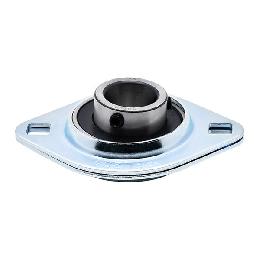
With a two-piece housing made from thin pressed metal, these bearings are a cost-effective option when extreme precision isn't necessary. Less stable than bearings with forged, one-piece housings, they're good for hand-cranked systems, gravity feed conveyor rollers, and other low-speed applications. The balls inside roll nearly friction-free to support smooth shaft rotation. The housing mounts in place with a two-bolt flange, the most common type of flanged bearing. Lubricate regularly to keep your bearing in tip-top shape. These bearings come packed with grease and sealed to block out dust and contaminants. Steel Housing — Best for dry environments as moisture will cause them to rust. Set Screw — Turn the screw to lock your shaft in place. A simple, reliable choice, set screws grip tightly, but they can mar shaft surfaces.
With a two-piece housing made from thin pressed metal, these bearings are a cost-effective option when extreme precision isn't necessary. Less stable than bearings with forged, one-piece housings, they're good for hand-cranked systems, gravity feed conveyor rollers, and other low-speed applications. The balls inside roll nearly friction-free to support smooth shaft rotation. The housing mounts in place with a two-bolt flange, the most common type of flanged bearing. Lubricate regularly to keep your bearing in tip-top shape. These bearings come packed with grease and sealed to block out dust and contaminants. Steel Housing — Best for dry environments as moisture will cause them to rust. Set Screw — Turn the screw to lock your shaft in place. A simple, reliable choice, set screws grip tightly, but they can mar shaft surfaces. Misalignment Capability — Bearings compensate for as much shaft misalignment as the degree listed. This extends the life of the bearing and protects against wear if shafts are slightly askew.
With a two-piece housing made from thin pressed metal, these bearings are a cost-effective option when extreme precision isn't necessary. Less stable than bearings with forged, one-piece housings, they're good for hand-cranked systems, gravity feed conveyor rollers, and other low-speed applications. The balls inside roll nearly friction-free to support smooth shaft rotation. The housing mounts in place with a two-bolt flange, the most common type of flanged bearing. Lubricate regularly to keep your bearing in tip-top shape. These bearings come packed with grease and sealed to block out dust and contaminants. Steel Housing — Best for dry environments as moisture will cause them to rust. Set Screw — Turn the screw to lock your shaft in place. A simple, reliable choice, set screws grip tightly, but they can mar shaft surfaces.
With a two-piece housing made from thin pressed metal, these bearings are a cost-effective option when extreme precision isn't necessary. Less stable than bearings with forged, one-piece housings, they're good for hand-cranked systems, gravity feed conveyor rollers, and other low-speed applications. The balls inside roll nearly friction-free to support smooth shaft rotation. The housing mounts in place with a two-bolt flange, the most common type of flanged bearing. Lubricate regularly to keep your bearing in tip-top shape. These bearings come packed with grease and sealed to block out dust and contaminants. Steel Housing — Best for dry environments as moisture will cause them to rust. Set Screw — Turn the screw to lock your shaft in place. A simple, reliable choice, set screws grip tightly, but they can mar shaft surfaces. Misalignment Capability — Bearings compensate for as much shaft misalignment as the degree listed. This extends the life of the bearing and protects against wear if shafts are slightly askew.
With a two-piece housing made from thin pressed metal, these bearings are a cost-effective option when extreme precision isn't necessary. Less stable than bearings with forged, one-piece housings, they're good for hand-cranked systems, gravity feed conveyor rollers, and other low-speed applications. The balls inside roll nearly friction-free to support smooth shaft rotation. The housing mounts in place with a two-bolt flange, the most common type of flanged bearing. Lubricate regularly to keep your bearing in tip-top shape. These bearings come packed with grease and sealed to block out dust and contaminants. Steel Housing — Best for dry environments as moisture will cause them to rust. Set Screw — Turn the screw to lock your shaft in place. A simple, reliable choice, set screws grip tightly, but they can mar shaft surfaces.
With a two-piece housing made from thin pressed metal, these bearings are a cost-effective option when extreme precision isn't necessary. Less stable than bearings with forged, one-piece housings, they're good for hand-cranked systems, gravity feed conveyor rollers, and other low-speed applications. The balls inside roll nearly friction-free to support smooth shaft rotation. The housing mounts in place with a two-bolt flange, the most common type of flanged bearing. Lubricate regularly to keep your bearing in tip-top shape. These bearings come packed with grease and sealed to block out dust and contaminants. Steel Housing — Best for dry environments as moisture will cause them to rust. Set Screw — Turn the screw to lock your shaft in place. A simple, reliable choice, set screws grip tightly, but they can mar shaft surfaces. Misalignment Capability — Bearings compensate for as much shaft misalignment as the degree listed. This extends the life of the bearing and protects against wear if shafts are slightly askew.
With a two-piece housing made from thin pressed metal, these bearings are a cost-effective option when extreme precision isn't necessary. Less stable than bearings with forged, one-piece housings, they're good for hand-cranked systems, gravity feed conveyor rollers, and other low-speed applications. The balls inside roll nearly friction-free to support smooth shaft rotation. The housing mounts in place with a two-bolt flange, the most common type of flanged bearing. Lubricate regularly to keep your bearing in tip-top shape. These bearings come packed with grease and sealed to block out dust and contaminants. Steel Housing — Best for dry environments as moisture will cause them to rust. Set Screw — Turn the screw to lock your shaft in place. A simple, reliable choice, set screws grip tightly, but they can mar shaft surfaces.