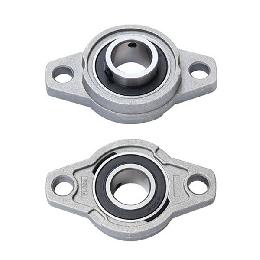
Leave the lubricant in the supply closet— these low-maintenance bearings are made from naturally slippery plastic. They'll keep shafts spinning with no messy grease to drip off, wash out, or collect dust. With no moving parts, sleeve bearings stand up to grimy environments better than ball bearings. However, with more friction generated, they're less effective at high speeds. The sturdy housing supports the shaft and secures with a two-bolt flange, the most common type of flanged bearing. High - Load Bronze - Backed PTFE — Reinforced with metal, these slick PTFE bearings carry load ratings at least seven times greater than any plastic alternative. The slippery material is a good fit for conveyors and other machinery with frequent starts and stops. Aluminum Housing — One-third the weight of cast iron but not as strong. Aluminum also resists corrosion. Misalignment Capability — Bearings compensate for as much shaft misalignment as the degree listed. This extends the life of the bearing and protects against wear if shafts are slightly askew.
Leave the lubricant in the supply closet— these low-maintenance bearings are made from naturally slippery plastic. They'll keep shafts spinning with no messy grease to drip off, wash out, or collect dust. With no moving parts, sleeve bearings stand up to grimy environments better than ball bearings. However, with more friction generated, they're less effective at high speeds. The sturdy housing supports the shaft and secures with a two-bolt flange, the most common type of flanged bearing. Ultra - Low - Friction PTFE - Filled Acetal — Made from a special blend of acetal and PTFE, these extra-slippery bearings are ideal for conveyors and other machinery with frequent starts and stops. Aluminum Housing — One-third the weight of cast iron but not as strong. Aluminum also resists corrosion. Misalignment Capability — Bearings compensate for as much shaft misalignment as the degree listed. This extends the life of the bearing and protects against wear if shafts are slightly askew.
Leave the lubricant in the supply closet— these low-maintenance bearings are made from naturally slippery plastic. They'll keep shafts spinning with no messy grease to drip off, wash out, or collect dust. With no moving parts, sleeve bearings stand up to grimy environments better than ball bearings. However, with more friction generated, they're less effective at high speeds. The sturdy housing supports the shaft and secures with a two-bolt flange, the most common type of flanged bearing. Acetal — The most common choice for plastic bearings, acetal is wear-resistant and affordable. Aluminum Housing — One-third the weight of cast iron but not as strong. Aluminum also resists corrosion. Misalignment Capability — Bearings compensate for as much shaft misalignment as the degree listed. This extends the life of the bearing and protects against wear if shafts are slightly askew.